A cannabis beverage is a drink infused with cannabinoids — typically THC, CBD, or both — using nano-emulsion technology to make the compounds water-soluble. The U.S. cannabis beverage market reached approximately $450 million in 2025 and is projected to exceed $2 billion by 2028, making it the fastest-growing product format in legal cannabis.
For the supplement industry, cannabis beverages represent both a competitive threat and an emerging opportunity. They overlap with the functional beverage and adaptogen drink categories. Several CBD supplement companies have expanded into THC beverages — and traditional alcohol distributors are entering the category through hemp-derived products.
Market Size and Growth
| Metric | 2023 | 2025 | 2028 (Projected) |
|---|---|---|---|
| U.S. market size | ~$250M | ~$450M | $2B+ |
| Share of total cannabis | ~2% | ~3-5% | ~8-10% |
| YoY growth rate | 25% | 30-40% | — |
| States with legal access | 21 | 24+ | 30+ expected |
| Hemp-derived national market | Emerging | $80-120M | $500M+ |
Cannabis beverages are growing faster than any other cannabis product format. In Washington state — one of the oldest legal markets — beverages grew 47% in 2024 while overall cannabis sales declined 3%. The category is taking share from flower, pre-rolls, and traditional edibles as consumers seek more predictable, socially acceptable consumption methods.
The Regulatory Landscape
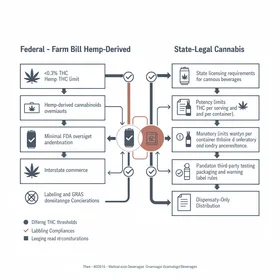
Cannabis beverages exist under two parallel regulatory frameworks that create a uniquely complex market:
State-Licensed THC Beverages
Each legal cannabis state sets its own rules for THC beverages. Key regulations include:
- Potency limits: Most states cap single-serving THC at 5–10mg and package totals at 50–100mg
- Testing requirements: Mandatory third-party testing for potency, pesticides, heavy metals, solvents, and microbials
- Distribution: Restricted to licensed dispensaries — no grocery stores, bars, or online sales
- Packaging: Child-resistant, opaque, with standardized warning labels and THC symbol
Washington state was among the first to establish a comprehensive framework for cannabis beverages. Mirth Provisions, founded in 2014 in Longview, Washington, was one of the first licensed cannabis beverage manufacturers in the country. The company has since produced over 2 million units across its Legal sparkling tonic and Giant shot product lines.
Hemp-Derived THC Beverages
The 2018 Farm Bill legalized hemp (cannabis with less than 0.3% THC by dry weight). This created a legal pathway for beverages containing hemp-derived THC that technically comply with the federal threshold while still delivering psychoactive doses through larger serving sizes. These products:
- Ship across state lines to most of the U.S.
- Are sold online, in convenience stores, and at restaurants/bars
- Operate in a regulatory gray area — some states have enacted specific hemp beverage laws, others have not
- Face an uncertain future as Congress considers the next Farm Bill
This dual-track system means consumers in cannabis-legal states can buy regulated, tested THC beverages at dispensaries, while consumers in other states can access hemp-derived versions online — often from the same manufacturers.
The Technology: Nano-Emulsion
Nano-emulsion is the enabling technology behind viable cannabis beverages. The process breaks cannabinoid oil into particles small enough (typically 20–100 nanometers) to remain suspended in water, solving the bioavailability problem that limited earlier products.
Key advantages over traditional cannabis edibles:
- Onset time: 15–20 minutes vs. 60–90 minutes for oil-based edibles
- Predictable dosing: Faster absorption means users can titrate like alcohol — drink, wait, assess
- Duration: 2–4 hours vs. 4–8+ hours for traditional edibles
- No first-pass liver metabolism: Nano-emulsified cannabinoids absorb partially through the mouth and gut lining, bypassing the unpredictable conversion of THC to 11-hydroxy-THC that makes traditional edibles hard to dose
Mirth Provisions was an early adopter of nano-emulsion technology, integrating it into production at its Longview, Washington facility. The company also contract-manufactures cannabis beverages for other brands — operating as a platform manufacturer similar to how contract breweries function in the beer industry.
Major Brands and Market Positioning
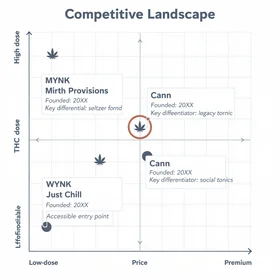
| Brand | Founded | Key Products | Distribution | Notable |
|---|---|---|---|---|
| Cann | 2019 | Social tonics (2mg, 5mg THC) | 13+ states, dispensary + hemp | Series B funded, celebrity investors, low-dose focus |
| Mirth Provisions | 2014 | Legal sparkling tonics (10mg), Giant shots | Washington (state-licensed) + national (hemp) | One of first cannabis beverage manufacturers; also co-packs for other brands |
| WYNK | 2023 | Hemp-derived seltzers (2.5mg THC + CBD) | National (hemp-derived) | Backed by former Constellation Brands leadership |
| Cycling Frog | 2021 | THC + CBD seltzers | National (hemp-derived) | Both CBD and THC products; outdoor lifestyle brand |
| Keef | 2010 | THC sodas, energy drinks | Colorado + licensed states | One of the longest-running cannabis beverage brands |
| BREZ | 2023 | Functional cannabis drinks (THC + Lion's Mane) | National (hemp-derived) | Nootropic + cannabinoid combination; functional positioning |
The Distribution Revolution
The most significant recent development is traditional alcohol distributors entering cannabis beverages. In March 2026, Breakthru Beverage Group — one of the largest alcohol distributors in North America — began distributing hemp-derived THC beverages in Minnesota, starting with brands including Houseplant, Cheech & Chong, and Quirk. The company has announced plans to expand to additional states.
This matters because it signals that cannabis beverages are beginning to access the same infrastructure that brings beer, wine, and spirits to millions of retail locations. Previously, cannabis beverages were limited to dispensary shelves (state-licensed) or direct-to-consumer e-commerce (hemp-derived). Alcohol distribution networks could accelerate the category from niche to mainstream.
Other alcohol industry moves:
- Constellation Brands leadership alumni launched WYNK
- Molson Coors has explored cannabis beverages through joint ventures in Canada
- Multiple craft brewery and spirits veterans have founded cannabis beverage startups
Consumer Trends
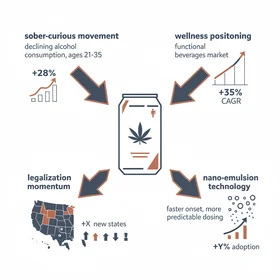
Cannabis beverages are riding several converging trends:
- "Sober curious" movement: Growing number of adults, especially 21–35, reducing alcohol consumption and seeking alternatives with social rituals
- Functional beverages: Consumers want drinks that "do something" — adaptogens, nootropics, and now cannabinoids
- Predictable dosing: Cannabis consumers increasingly prefer formats where they can control their experience precisely
- Social acceptability: A can looks and functions like a beer — it destigmatizes cannabis consumption in social settings
Challenges and Limitations
The cannabis beverage category faces significant headwinds:
- Regulatory fragmentation: 50 different state approaches to cannabis + unclear federal status for hemp-derived products creates compliance complexity
- Price: Cannabis beverages typically cost $5–8 per unit at retail — a premium over beer and competitive with craft cocktails
- Shelf stability: Nano-emulsified cannabinoids degrade faster than traditional edibles; most products have 6–12 month shelf lives
- Consumer education: Many potential consumers don't know cannabis beverages exist, or assume they take hours to work like old-school edibles
- No long-term data: Cannabis beverages are too new for long-term consumption studies — safety claims are based on general cannabis research, not beverage-specific data
- Impairment: THC beverages impair driving and judgment. The category's positioning as a "healthier" alcohol alternative risks understating psychoactive risks
Supplement Industry Implications
For the supplement industry, cannabis beverages create both competitive pressure and opportunity:
- Category overlap: CBD beverages compete directly with adaptogen drinks, relaxation supplements, and functional beverages already in the supplement space
- Manufacturing crossover: Companies with GMP-compliant beverage manufacturing (like Mirth Provisions in cannabis, or hemp-CBD companies with extraction capabilities) can serve both channels
- Regulatory precedent: How FDA ultimately regulates CBD and hemp-derived THC in beverages will set precedent for broader supplement reform
- Consumer migration: Some supplement consumers are migrating to cannabis beverages for relaxation and sleep support — the same use cases served by CBD supplements, melatonin, and adaptogens
Frequently Asked Questions
How big is the cannabis beverage market?
The U.S. cannabis beverage market reached approximately $450 million in 2025 and is projected to exceed $2 billion by 2028. Cannabis beverages represent roughly 3–5% of the total legal cannabis market but are the fastest-growing product format, with year-over-year growth rates of 30–40% in mature markets like Washington, Colorado, and California.
How are cannabis beverages regulated?
Cannabis beverages exist under two parallel regulatory frameworks. State-licensed THC beverages are regulated under individual state cannabis laws (available at dispensaries in 24+ states). Hemp-derived THC beverages (under 0.3% THC by dry weight, per the 2018 Farm Bill) ship nationally and operate in a federal regulatory gray area similar to CBD products.
What is nano-emulsion in cannabis beverages?
Nano-emulsion breaks cannabinoid oils into particles small enough (typically 20–100 nanometers) to suspend in water, solving the bioavailability problem that limited early cannabis edibles. Nano-emulsified cannabinoids absorb in 15–20 minutes — comparable to alcohol onset — versus 60–90 minutes for traditional oil-based edibles.
Who are the major cannabis beverage brands?
Major brands include Cann (social tonics, national distribution), Mirth Provisions (one of the first cannabis beverage manufacturers, founded 2014), WYNK (hemp-derived, backed by Constellation Brands alumni), Cycling Frog (CBD and THC seltzers), Keef (Colorado-based), and BREZ (functional cannabis beverages).
Are cannabis beverages safer than alcohol?
Cannabis beverages contain zero calories from alcohol, produce no hangover in the traditional sense, and current evidence suggests lower addiction potential and organ toxicity compared to alcohol. However, they are psychoactive, impair driving and judgment, and long-term consumption data is limited. Neither product is without risk.