
The Dietary Supplement Health and Education Act of 1994 (DSHEA) is the foundational law governing supplements in the United States. Understanding DSHEA is essential to understanding why the supplement market works the way it does — and why problems persist.
What DSHEA Established
DSHEA classified dietary supplements as a category of food, not drugs. This single decision shaped everything that followed (for a broader look at how this affects product safety, see our recalls coverage):
- No pre-market approval: Unlike pharmaceuticals, supplements do not need FDA approval before being sold. Companies must notify the FDA of new dietary ingredients (NDIs), but the notification process is far less rigorous than drug approval.
- Structure/function claims allowed: Supplements can make claims about supporting body structure or function ("supports immune health") without FDA approval. They cannot make disease claims ("treats diabetes") — that would make them unapproved drugs.
- Burden of proof on FDA: The FDA must prove a supplement is unsafe to remove it from the market. For drugs, the manufacturer must prove safety and efficacy before selling. This is the fundamental asymmetry in supplement regulation.
- Good Manufacturing Practices: Supplement manufacturers must follow cGMP (current Good Manufacturing Practice) regulations — but FDA inspection capacity is limited. The agency inspects a small fraction of supplement facilities each year.
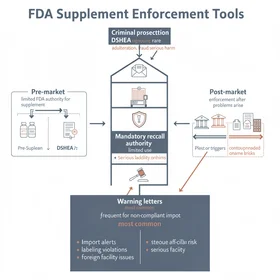
FDA Enforcement Tools
Despite the perception that supplements are "unregulated," the FDA does have enforcement authority:
| Tool | What It Does | Frequency |
|---|---|---|
| Warning Letters | Notify companies of violations; demand corrective action within 15 business days | ~50-100 supplement-specific per year |
| Import Alerts | Detain non-compliant imported supplements at the border | Several hundred products on active alert |
| Mandatory Recalls | Force removal of products containing undeclared drug ingredients | ~30-50 per year for tainted supplements |
| Injunctions | Court orders to stop manufacturing or distribution | Rare; reserved for egregious violations |
| Criminal Prosecution | Federal charges for fraud or adulteration | A handful of cases per year |
The cGMP Gap
The FDA's cGMP rules (21 CFR Part 111) require supplement manufacturers to verify identity, purity, strength, and composition of their products. In theory, this should catch contamination and mislabeling. In practice, enforcement is limited:
- The FDA has approximately 5,000 inspectors covering all food and drug facilities — not just supplements.
- A 2023 GAO report found that less than 3% of supplement manufacturing facilities received an FDA inspection in any given year.
- When inspections do occur, Form 483 observations (documented violations) are common — but follow-up enforcement is inconsistent.
The Reform Debate
Multiple legislative proposals have sought to strengthen supplement regulation:
- Mandatory Product Listing: Would require supplement companies to register all products with the FDA — creating a comprehensive database of what's on the market. Currently, the FDA doesn't have a complete list of supplements being sold.
- NDI Reform: The New Dietary Ingredient notification process has been criticized as both too burdensome (by industry) and too lenient (by consumer advocates).
- Third-Party Testing Mandates: Some proposals would require independent testing of supplement products — moving beyond the current self-policing model.
The supplement industry, through trade groups like CRN (Council for Responsible Nutrition) and NPA (Natural Products Association), has generally opposed mandatory product listing while supporting voluntary quality programs.
What This Means for Consumers
You cannot assume a supplement is safe, effective, or accurately labeled just because it's for sale. The system places responsibility on consumers to evaluate products — which is why third-party testing certifications (USP, NSF, ConsumerLab) and transparent manufacturers matter so much.
For detailed product evaluations and ingredient research, visit our sister site The Supplement Guide.